Reality Check, Part 2
Magic design lead Mark Rosewater details how Set Design and Commander Design brought Reality Fracture to life. The article covers the creation of the empower Jace mechanic and how the set shifted focus to a Phyrexian-free Mirrodin.
- Mark Rosewater breaks down the Set Design and Commander Design teams for Reality Fracture.
- Set Design was led by Yoni Skolnik; Commander Design was led by Gavin Verhey.
- The standalone Multiverse Reforged Commander deck features a brand-new Polymorph theme.
- The empower Jace mechanic originated as a what-if spin on the classic amass keyword.
Assembling the Design Teams
The transition from vision design to set design is a crucial handoff in any Magic: The Gathering expansion. For Reality Fracture, set design leadership was handed to Yoni Skolnik, who previously led design efforts on Strixhaven: School of Mages and Aetherdrift. Skolnik worked alongside a multidisciplinary team to refine limited draft environments, tune complex game rules for digital play, and establish competitive balance for Constructed formats.
The set's accompanying Commander release took a unique path under the direction of Gavin Verhey. Instead of a typical suite of multiple preconstructed options, this release features a single deck focused on a dedicated Polymorph strategy. Game design intern Tom played a major role in crafting the decklist, laying the foundation for a theme centered around Jace altering reality and transforming creatures.
Designing the Empower Jace Mechanic
Representing a central villain like Jace Beleren across an entire set presented a major mechanical hurdle. To ensure his presence felt pervasive without diluting card utility, design team member Jeremy Geist pitched a variant of the amass keyword. Originally dubbed 'amass Jace,' the mechanic was designed to create a planeswalker token or build loyalty on existing Jace planeswalkers.
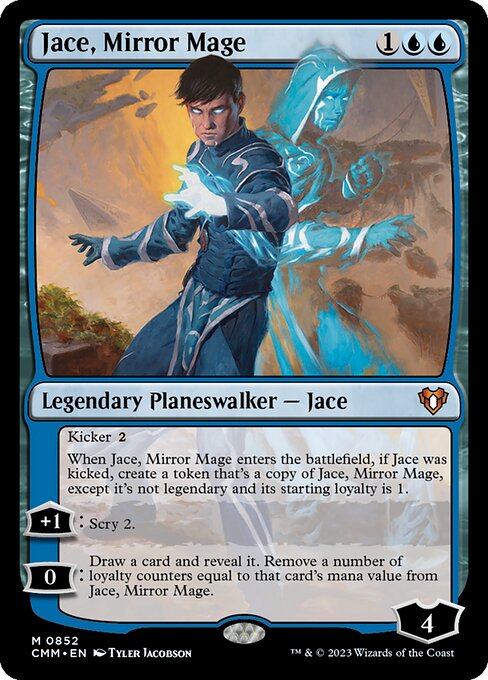
The final mechanic, named empower Jace, retained its core functionality from early playtesting. When cards trigger this effect, players create a Jace Echo planeswalker token - or add loyalty counters to one they already control - giving blue-aligned decks ongoing value through built-in surveil and card-draw abilities. Cards like Jace, Mirror Mage interact directly with these tokens, locking in high-synergy play patterns for Limited and Casual formats alike.
Refining the Set Structure
Initial vision design explored a broad structure spanning ten color pairs across ten iconic planes. However, player feedback from March of the Machine indicated that jumping across too many worlds diluted the overarching story. As a result, the team decided to consolidate the set's narrative focus onto a single location: a timeline where Mirrodin was never corrupted by New Phyrexia.
This alternate reality setting, known historically as Mirrodin Pure, allowed designers to lean heavily into familiar artifact themes and altered character identities. Focusing the expansion on this iconic setting gave the design team room to pair high-level rules innovations with nostalgia-driven what-if scenarios across both standard booster packs and Commander products.